
I was looking for an office chair on Amazon, and at one point, I stopped to look at the brand names.
Not the chairs. The names.
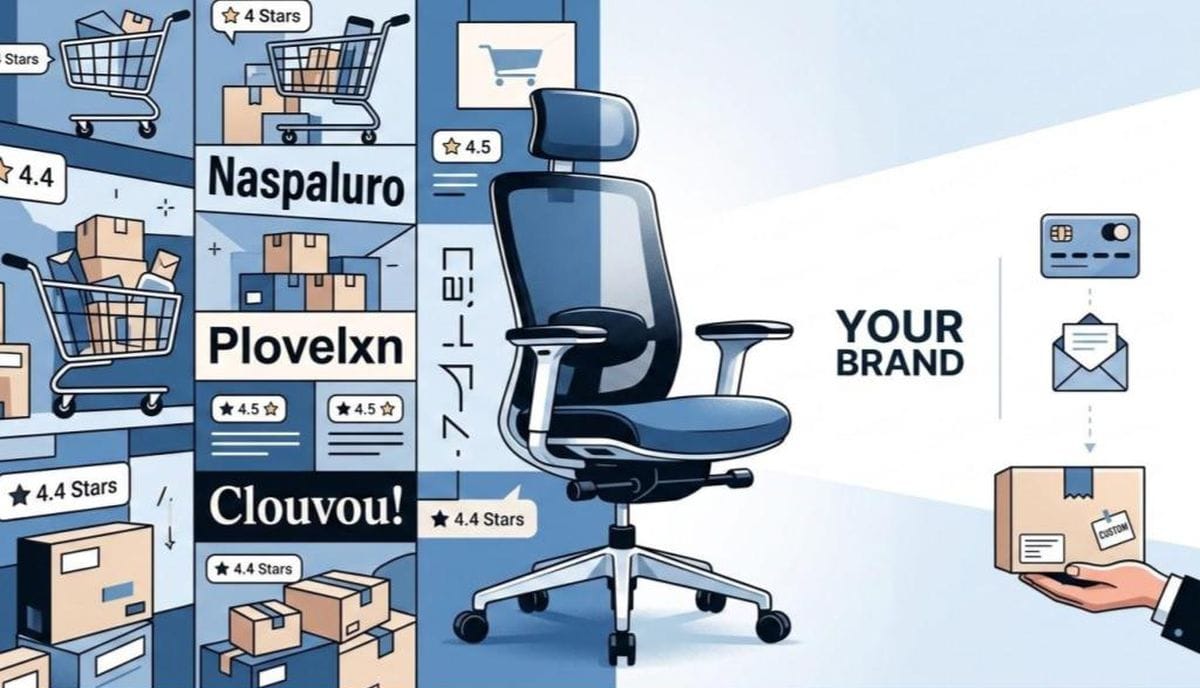
After a while, you start seeing seemingly decent products, maybe even well-reviewed, sold by brands that look like they were generated by slamming a keyboard: and prestigious brands like Naspaluro, Plovelxn, or Clouvou! appear.
And then a question came to my mind: “How is it possible that companies capable of producing objects that are good, competitive, well-photographed, with thousands of reviews, then present themselves to the world with a name that looks like a typo?”
The easy answer is: “They don’t know how to do branding.”
Maybe. But it’s too convenient an answer. Is that really the case?
The more interesting answer is another: perhaps, inside certain marketplaces, the seller’s brand matters much less than we like to tell ourselves. Or rather: it matters, but it often comes after other parameters such as price, availability, reviews, delivery times, return policies, and trust in the platform.
The point is not that branding is no longer useful.
The point is that if you sell inside someone else’s house, a huge part of the branding is being done by that someone else instead of you.
Those absurd names aren’t always born by chance
An article by SlashGear tried to explain why there are so many brands with strange names on Amazon, especially among international sellers and Asian manufacturers. The issue is not just linguistic or cultural. It also involves issues you might not think of, such as trademark registration, name uniqueness, and access to brand protection and management tools within Amazon.
In practice: an invented name, even if ugly but unique, can be easier to register and less exposed to conflicts compared to a “nice” name already used by someone somewhere in the world.
This directly connects to the Amazon Brand Registry. Official documentation explains that to enroll a brand in the program, you need a registered trademark or at least a pending registration application.
- In other words, in certain cases, we aren’t looking at “ugly names because nobody thought about it.” We are looking at names functional to a system like the one Amazon wants!
- Names unique enough to be registrable,
- Neutral enough not to create legal issues,
- Fast enough to allow listing products online and starting to sell.
So, ugly yes, but there is a reason.
Inside Amazon, that name doesn’t have to build trust, reputation, and peace of mind: that job is already done by the platform. You don’t care if that brand makes junk, because at worst, Amazon takes care of resolving the issue with a return.
And here the real problem begins, which is that on Amazon, you often don’t buy a brand. You buy a combination of signals.
What do I mean? When you search for an office chair on Amazon, in most cases, you don’t start by saying: “I absolutely want to buy a Plovelxn chair.”
You start from a need: ergonomic chair, lumbar support, adjustable armrests, fast delivery, decent price, acceptable reviews. Then you start comparing product sheets that all look alike: photos on a white background, vaguely ergonomic promises, stars, coupons, delivery tomorrow, easy returns.
The brand name often comes later. And often, you just don’t care.
The marketplace creates an alternative trust system. I don’t know Plovelxn, but I know Amazon. I see 4.4 stars, 2,813 reviews, Prime shipping, and return options. I don’t know if the mythical Plovelxn will still exist three years from now, but who cares, I can receive the product tomorrow and, if things go wrong, send it back.
A study reported by Digital Commerce 360 on marketplace behavior in 2024 goes in this exact direction: 49.26% of surveyed consumers stated they would buy on marketplaces from brands or sellers they had never heard of before. The same article reports that 59.19% always look at ratings and reviews and usually base their decision on them, while only 4.52% say they never look at them.
The brand doesn’t disappear. But it gets crushed inside a comparison grid where everyone seems more or less equivalent. And when everyone seems equivalent, whoever appears less risky, more convenient, or faster wins.
However, be careful: I don’t want to get to the point where marketplaces are evil and shouldn’t be used! Watch out!
The marketplace is an accelerator that also takes care of marketing and logistics. It provides us with an impressive mass of demand, proven logistics, payment systems that put everyone at ease, review systems, advertising infrastructure, seller tools, and enormous trust from users.
So it would be silly to say: “Don’t sell on marketplaces.”
The problem isn’t using Amazon; the problem is thinking that Amazon is a brand strategy. Selling a lot doesn’t mean building an identity or a successful brand!
Here, many companies get confused.
They get confused because they look at orders, revenue, reviews, ranking, maybe even month-over-month growth, and think they are building a brand. But you aren’t building a brand—the customer probably won’t even remember your name. Remember that they bought on Amazon and shipping was fast.
They don’t subscribe to your newsletter. They don’t know your story. They don’t discover your complete catalog, listen to your storytelling, or understand your value proposition. They don’t live an experience designed by you from start to finish.
They buy. Maybe they are satisfied. But they don’t necessarily become “your” customer.
This is the difference between having orders and having a relationship.
If the customer doesn’t know who you are, doesn’t recognize you, doesn’t search for you, doesn’t return directly to you, and doesn’t distinguish you from the product next door, then the value you are building is fragile.
At this point, someone might say: “Fine, then I’ll build a proprietary e-commerce site and solve it.”
If only.
Proprietary e-commerce is not a trivial matter at all. It is harder, slower, more expensive. If no one knows you, traffic doesn’t come on its own. If the website is poorly made, people leave. If the positioning is generic, you look like everyone else. If the value proposition is weak, you won’t sell.
However, if you do things well, on your proprietary e-commerce, you can explain why you exist, what problem you solve, what you do better than others, why your product costs more, or why it’s different. You can work on content, comparisons, buying guides, post-sales, customer support, newsletters, packaging, community, and retention.
You can transform a buyer into a customer and create loyalty. But it’s hard!
So, what should a company do?
The boring but true answer is: it depends on the product, margin, category, level of competition, customer behavior, and the company’s ability to sustain a proprietary channel.
However, a few questions help avoid kidding ourselves.
If you sell on marketplaces, ask yourself if people remember your brand after purchasing or if they only remember Amazon. Ask yourself if you can bring value outside the product listing or if you compete almost exclusively on price, availability, and reviews. Ask yourself how much your growth depends on internal platform advertising and how much real margin remains after fees, logistics, promotions, and returns. Ask yourself what would happen if tomorrow an algorithm changed, a more aggressive competitor entered, or costs to stay visible increased.
If you have a proprietary e-commerce site, ask yourself if you are truly building a different experience or if you just replicated an online catalog. Ask yourself why someone should buy from you instead of Amazon. Ask yourself if you are using content, email, customer care, and post-sales to build a relationship or if you just wait for traffic that never arrives. Ask yourself, above all, if your brand gives the customer a reason to return.
You don’t have to choose one or the other!
What you need to do is design the mix.
- Use Marketplaces to intercept demand.
- Use your proprietary E-commerce to build relationships.
And I still haven’t chosen whether to buy a Naspaluro or Plovelxn chair!