
In 2020 we discussed the “management gap”. A few years have passed since then, and in that time a great deal has changed: laws, technology, cost structures, remote working… so many things.
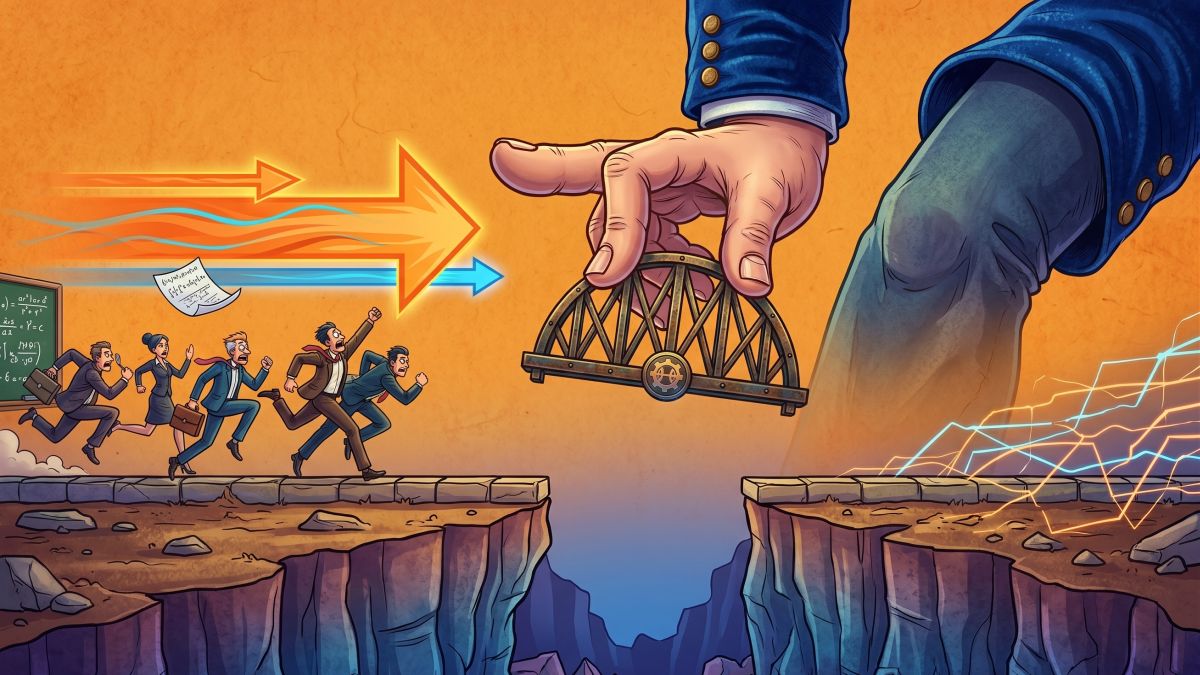
Back in 2020, we spoke of it as an adaptation issue, as a structural problem. Today, in 2026, it is no longer a risk: it is a reality that is holding many companies back. Whether they are large or small, it doesn’t matter.
These days, the skills gap is no longer just a statistic discussed at conferences; it’s the reason why your digital transformation has stalled, whilst competitors (especially those abroad) are eating into your margins.
2020 vs 2026: We haven’t learnt a thing
Six years ago, the figures spoke for themselves: 59% of SMEs were ignoring training; today, we have moved from denial to paralysis: according to the report by the 4.Manager observatory of December 2025, 65% know they need to change, but do not know where to start.
Let’s start by looking at where we were. In 2020, the situation was more or less as follows:
- 41% of companies had training programmes in place
- 59% did NOT include training in their transformation strategies
- Managers were aware of the gap but showed little interest in training programmes
Today, the situation has got worse because the world is moving at twice the speed.
- For 63% of businesses worldwide, the skills gap is the main obstacle to survival.
- Italy is lagging behind: Only 45.8% of the population has basic digital skills. The EU average stands at 55.6%. We’re bottom of the class and we keep blaming others.
‘Old-school’ management
More than 40% of Italian executives are over 55.
Experience is valuable, but if 39% of the skills you need today will have changed by 2030, your experience risks becoming a broken compass. If your managers haven’t undergone rigorous upskilling, then you probably won’t make it to 2030. By 2026, experience without upskilling is nothing but dead weight.
Take routine, repetition, the ‘arrogance’ born of experience, and a reluctance to learn new things or adapt, and the mix will be a poisonous one.
As if that weren’t enough, over 50% of companies report difficulties in finding candidates who combine managerial skills with specialisations in ICT, data and sustainability. Is this a surprise? I don’t think so. The trend was (and is) clear: we are moving towards a management style capable of making decisions based on data that often comes from digital sources, knowing what data we want and can collect and analyse, and ensuring we are supported by ICT. Because managers read and interpret the figures, but the implementation of systems for measuring and sharing information almost always comes from ICT!
The illusion of ‘I can’t find any staff’
It is not just difficult to find people; it is difficult to find the right ones. 78% of Italian organisations struggle to recruit, particularly due to a lack of the required hard skills (57%) and soft skills (36%) .
Is it down to a lack of training? No. It’s because there hasn’t yet been enough time for certain professional roles to develop. Looking for a “senior AI-integrated logistics expert” is like looking for a smartphone expert in 2008: you can’t find one, because the time needed to develop that role simply hasn’t passed yet.
This brings us back to the issue of staff training: companies must invest in the development of their human resources. Rather than looking for those resources and skills ‘outside’, they need to be developed ‘in-house’. It is a cost, it is an investment, but it has to be done.
Artificial Intelligence: it is neither a game nor a passing fad
Whilst the world is talking about prompt engineering (a 112% increase in searches) and process automation, here we are still wondering whether ChatGPT is actually useful, or just using it to help us write an email. Not learning to use AI today means consciously choosing to be less efficient, slower and more expensive. It’s nothing short of tactical suicide.
Forecasts predict an 87% increase in demand for AI and Big Data skills by 2030. This will not be a passing trend, but a structural transformation of the labour market, where the ‘AI and Big Data’ sector has jumped to first place in terms of growth among the skills in demand globally.
The real tragedy, however, lies in the gap between what is happening globally and what is happening in Italy: whilst demand for experts is skyrocketing, the adoption of AI in our businesses remains stuck at a paltry 16.4%. This means that in just a few years’ time there will be a ruthless scramble to snap up the few people capable of managing data, and those who have not started training their staff today will find themselves with a technologically illiterate company.
It is not just a technical issue, but one of survival: this skills gap is already the main barrier to business transformation for 63% of employers. By 2030, any business owner who does not have staff capable of analysing Big Data to make strategic decisions will simply be out of the market, overwhelmed by competitors who have already automated their analysis and process efficiency.
So what does this mean for business owners? It’s simple… if demand for these skills rises by 87% but the supply remains stagnant, the cost of hiring such talent will triple. If you don’t have the budget of a multinational, the only smart move is to invest in training the staff you already have before it’s too late.
Oh well, so what?
So we need to take action. Otherwise, the consequences will be serious:
- Ridiculous recruitment costs: you’ll be paying a fortune for people whose skills will already be obsolete in two years’ time.
- Fortune-tellers instead of managers: a management team that doesn’t understand technology cannot make strategic decisions. You need people who can interpret data, not read tarot cards.
- Out of the running: competitors who use AI and have ‘hybrid’ managers (who are well-versed in data and ICT) will blow you away in terms of price and speed.
There’s only one conclusion: your employees, at every level, need to learn new things. This isn’t just advice; it’s the only way to keep your business afloat. Start investing in your managers’ skills, because new machinery, without someone who knows how to make the most of it, is just scrap metal.
Sources and Further Reading
In compiling this article, we have drawn on the most recent official reports, market surveys and statistical analyses (up to date as of March 2026).
1. The Starting Point (Back to 2020)
- Warp 7 — Original article: A gap in managerial skills (Michela Di Michele, 2020–2024).
2. Global Contexts and International Institutions
- World Economic Forum — Future of Jobs Report 2025:
- European Commission: Digital Skills and Jobs Platform — The Great Skills Reset
3. The Italian Context: Observatories and National Research
- Observatory 4.Manager (Confindustria + Federmanager):
- HR Innovation Practice Observatory (Milan Polytechnic):
- Mismatch Analysis: Hard vs Soft Skills (Data adapted from Manpower).
4. Technology Trends, AI and Skills Report
- Data Masters: AI and Data Skills Report 2025 — The Italian landscape
- Il Sole 24 Ore:
- BI-REX: Skill Gap Analysis: A Practical Guide for Businesses
5. HR Specialists and Market Analysts
- ManpowerGroup: Talent Shortage Survey — Recruitment Challenges 2025
- Kinetikon: Digital challenges and solutions for SMEs in 2025
- Zety Italia: The skills gap in Italy in 2024–2025