

Trolls, bots and fights in the comments: when engagement becomes a problem
You all know what a troll is, right?
Well, just in case: a troll is someone who enters a conversation not to contribute, but to ignite it.
They don’t really want to discuss. They want to provoke. They want to shift the focus. They want to turn a discussion into a brawl. Sometimes they do it with explicit insults, sometimes with feigned naive questions, sometimes with phrases designed specifically to get on someone’s nerves.
A troll, to put it bluntly, is the one who shows up under a customer care post and after three comments is already talking about medical dictatorship, powerful elites, or “you marketing people are all sellouts.”
A new figure? Not at all.
Trolls have existed practically since the internet began as a space for public conversation. Forums, newsgroups, chats, blogs, online communities: every time a place where people could discuss was born, someone arrived with the desire to throw gasoline on the fire. Platforms change, formats change, avatars change. The behavior remains surprisingly similar.
The troll is polarizing. It is provocative. It is often aggressive. Sometimes it does rage bait so obviously that it almost seems like a caricature: it writes an absurd thing not because it really believes it, but because it knows that someone won’t be able to resist the temptation to reply.
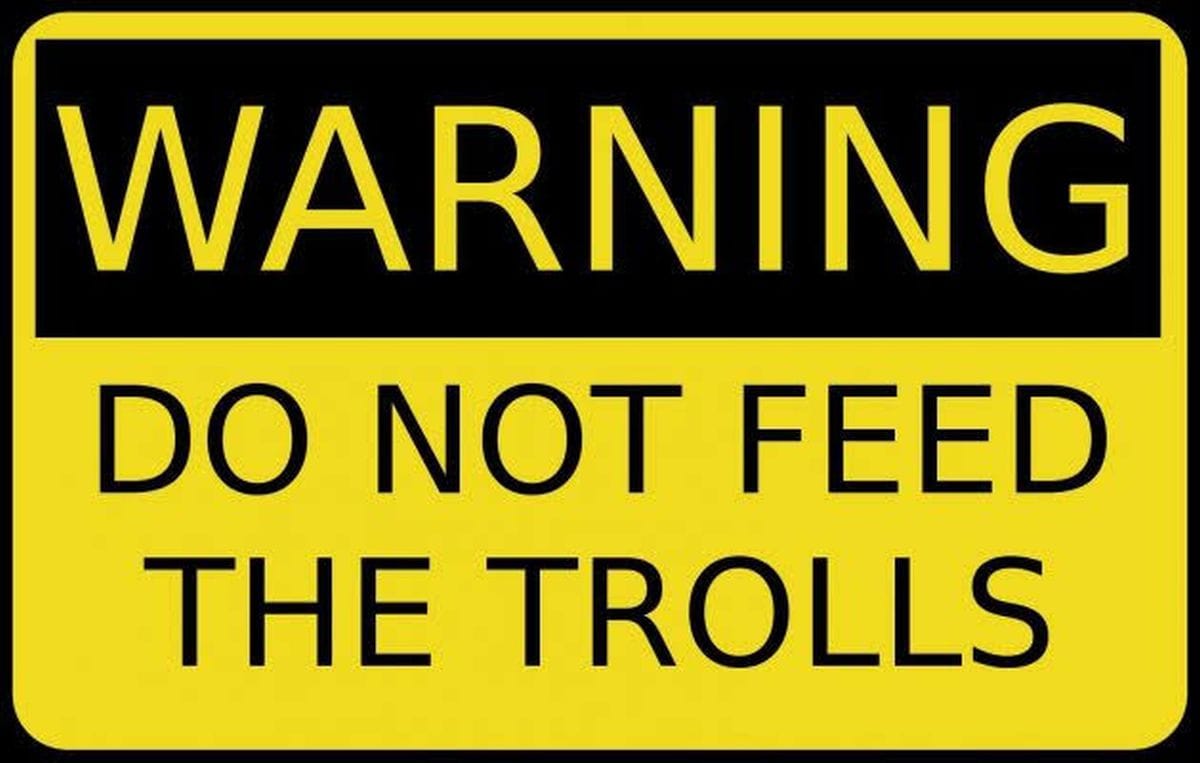
It’s no coincidence that one of the historical phrases of the internet is: “don’t feed the troll”.

Because the troll feeds on exactly that: attention, replies, indignation, wasted time. Every time you reply to “put them in their place,” you are often playing their game. You are giving them oxygen. You are giving them the center stage.
Social media is against trolls! Or is it?
In theory, the conclusion should be simple: if trolls are disruptive elements, social platforms should hate them. Pages should ban them. Groups should remove them as soon as they appear. Algorithms should penalize them without mercy.
Right?
In theory, yes.
In practice, as often happens, the real world is messier.
Because a troll ruins the quality of the conversation, but produces something that platforms know how to measure very well: engagement.
Comments. Replies. Reactions. Time spent under a post. Discussions that drag on. Users returning to check if someone has replied. Notifications. Counter-replies. Screenshots. Indignant shares.
All bad things for mental serenity.
But very interesting for a system that needs to understand which content keeps people hooked.
The point is this: conflict produces engagement. And even when it produces it in a sick way, even when it worsens the quality of the space, even when it turns a community into a boxing ring, it remains a strong signal.
And this is where the troll stops being just “the annoying one in the comments” and becomes something more interesting to understand.
Not because the troll themselves is important.
But because they show us a huge contradiction of social media: what hurts the conversation can be good for the numbers.
Engagement is still central for Meta, YouTube, and TikTok
Let’s leave aside feelings and conspiracy theories and look at the official documentation of the platforms.
Instagram, in its official explanation on how content ranking works, says the system uses various signals to predict how much a piece of content might interest a person. Among these signals are very concrete behaviors: likes, comments, shares, saves, the speed at which people interact, and the probability that they will perform certain actions. It is not a “one-button” system, but interactions remain a central part of the mechanism.
YouTube, in the official documentation on its recommendation system, explains that the goal is to help every user find videos they want to watch and maximize long-term satisfaction. To do this, it uses signals such as view volume, likes, hype, subscriptions, comments, feedback, satisfaction surveys, and user behavior. On the public page on how YouTube recommendations work, Google explicitly cites viewing behavior, likes, dislikes, subscriptions, and feedback. Here too: it is not just “the more you watch, the more I push,” but user behavior remains the raw material of the algorithm.
TikTok is even more explicit. On the official page How TikTok recommends content, the platform explains that the “For You” feed is also based on interactions like content you like, share, comment on, watch to the end, or skip. In other words: what you do, how long you stay, what you comment on, and what you share helps the system decide what to show you next.
So the point is not to say that Meta, YouTube, or TikTok “love trolls.” The point is subtler and more uncomfortable: if a brawl generates strong signals, the system can read it as interesting content, at least until other safety, quality, or moderation systems intervene.
And indeed, conflict works precisely because it makes people react.
A study published in PNAS, Out-group animosity drives engagement on social media, analyzed the relationship between hostility towards the opposing group and the spread of content on social media. The result, put simply: in political contexts, speaking ill of “the others” tends to generate more engagement. Not because it makes the discourse better, but because it makes it more reactive.
And here we arrive at the point: if a platform reads many interactions as a positive signal, and if conflict produces many interactions, then trolls are not an alien body to the system. They are a parasite that exploits the environment very well.
Trolls are not all the same: spontaneous, paid, automated
When we say “troll,” we risk putting everything in the same bag. That’s a mistake.
There is the spontaneous troll, the one that no one pays and no one coordinates. It is the real, or semi-real, person who uses social media as a venting ground. They enter groups, always comment on the same topics, provoke, insult, look for a fight. They don’t have an industrial strategy. They have time, anger, and a fairly evident need for attention.
Then there are bots, and here the discourse changes. A bot is not necessarily used to convince someone with sophisticated reasoning. It is often used to create volume: many comments, many reactions, many repetitions, many initial signals. A bot can artificially inflate the perception that a topic is “hot,” that many people think a certain way, that content is generating a spontaneous response from the public. With generative AI, this stuff becomes less crude than it used to be: we are no longer talking only about a profile that writes “beautiful content visit link” under every post. We are talking about accounts capable of producing plausible comments, adapted to the topic and less immediately recognizable.
The NATO Strategic Communications Centre of Excellence, in the report Social Media Manipulation for Sale, tested the possibility of purchasing fake engagement on large platforms in 2025. The experiment showed that over 30,000 fake accounts generated more than 100,000 interactions and the platforms almost didn’t notice. What does this mean? That the market for fake engagement exists, costs relatively little, and is harder to eliminate than we would like to think.
Then there are paid people. Here we must be careful not to slide into board-with-red-strings conspiracy theories, but the phenomenon exists and is documented. The Oxford Internet Institute has been studying organized social media manipulation campaigns for years, often defined as “computational propaganda”: a mix of automation, fake accounts, human operators, bots, trolls, influencers, and paid commentators used to orient or disturb public conversations. In the report Troops, Trolls and Troublemakers, the OII describes the organized use of these tools by political actors and coordinated subjects.
Why pay real people if bots exist? Because humans argue better.
Can you believe it? We’ve been asking ourselves for months “will AI replace us? will they steal our jobs?” and we discover that one thing they cannot replace us in is ARGUING! How wonderful!
The most effective model, however, seems to be the hybrid one: automation and bots to create mass, real people to give depth, credibility, and continuity to the provocation. In practice, it can work like this: a series of accounts immediately pushes content with comments and reactions, then some more credible profiles enter the discussion, reply to real users, fuel the conflict, and transform an artificial trigger into a real brawl.
At that point, the initial manipulation almost disappears. Only “the conversation” remains.
Why are real people asked for documents and certain bots stay online?
This is the part that drives many users crazy. And it is understandable.
You are a real person, you’ve had an account for years, maybe you manage a page, do advertising, administer a group, have photos, contacts, real relationships. Then one day the platform asks you to confirm your identity, upload a document, perform a verification. Meanwhile, you see clearly suspicious accounts that comment everywhere, insult everyone, and stay there. And even if you report them, the platform tells you that it hasn’t found any anomalies…
Improbable name. Stolen photo or meme. Identical comments. Serial insults. But no anomalies detected.
The question comes naturally: “So I have to prove I exist and these people don’t?”
The answer is: not exactly. Or rather, not always.
Meta, on the page Confirm your identity on Facebook, explains that it can request identity verification in various cases, for example, when it detects a security check, an access issue, or other situations where it wants to confirm that the account is managed by the correct person. In other contexts, Meta may require more specific verifications for high-visibility accounts, pages, advertisers, or profiles that reach many people. Already in 2020, Meta had announced verifications for profiles with non-authentic behavior and content that started to become viral in the United States.
This means an important thing: the document request is not the same process as the moderation of trolls in the comments.
Unfortunately, they are different systems. Identity verification is triggered for security reasons, account recovery, risk of unauthorized access, advertising activity, management of business accounts, and other things of that nature. The bot or the troll, instead, can stay below the threshold: they comment little, don’t buy advertising, don’t publish dangerous links, don’t steal anyone’s identity, don’t violate an automatic policy in an obvious enough way. They limit themselves to casting the bait of provocation and waiting for someone to bite.
Annoying? Very. But more realistic than the explanation “they leave them all there on purpose.”
But is it profitable for pages to have trolls in the comments?
Here is the right doubt. Not “Meta protects trolls,” but: is it profitable for pages to let trolls make a mess?
In the short term, often yes.
If a page lives on traffic, reach, and advertising monetization, then it can have a very large incentive. Simply put, if a post full of brawls generates more comments, more time spent, and more shares, that post can appear “performing.” And therefore you can “sell” the numbers it produces.
Often you don’t even need to pay someone to dirty the conversation. It is enough to publish ambiguous content, divisive titles, poorly constructed questions, and then not moderate. The rest is done by users, spontaneous trolls, and sometimes even piles of fake accounts.
This modus operandi has an increasingly common name: rage bait. Think about the fact that Oxford Languages chose “rage bait” as the word of the year 2025, and defines it as “content designed to provoke anger or outrage with the aim of generating traffic, attention or engagement”.
And in my opinion, it is a good description because it captures the transition from anger as a side effect to anger as a real editorial technique very well. Can we say that it is a bit like the evil brother of clickbait? In my opinion, yes. One plays on curiosity, the other on getting pissed off.
But we must not generalize and think that this is a strategy used by everyone. It is certainly a plausible scenario, but often if we find pages full of trolls it is not for strategy, maybe it is simply due to laziness in moderation or inability. And the fact that this doubt can arise is, in my opinion, quite indicative of how leaving the field open to trolls can be a double-edged sword in terms of reputation.
Because regardless of whether it is done with mens rea or simply because one is incapable, in the end, the result is the same: your social page is a dumpster. And you will pay the price in terms of reputation.
So what do we want to achieve? Quantity or quality?
The brawl is not health: it is noise
In marketing, there is a phrase that should be retired: “For better or for worse, the important thing is that people talk about it.”
It’s bullshit.
Maybe it can be okay for the television personality who lives on gossip and for the click-catching page. But if we are talking about companies, consultants, professionals, SMEs, brands, complex services, or any activity that needs trust, the continuous brawl is not good visibility. It is noise.
Would you enter a place seeing that right from the entrance there are people spitting in each other’s faces, insulting each other, and throwing plates?
Most of the best clients often don’t comment. They read. They watch. If they see a page left in disarray, they don’t think “interesting engagement.” They think “this page sucks.”
The difference is huge.
Good engagement builds relationship, trust, credibility, participation. Toxic engagement consumes attention, alienates sensible people, and accustoms the public to conflict. In the short term, it can inflate the numbers. In the long term, it can empty the value of the community.
The point is not how much engagement you make. It is what engagement you are making
Here the discourse concerns above all those who own a brand, a company, or a page and entrust social management to someone else. Because at the end of the month, it is easy to receive a beautiful report, full of green arrows: comments growing, interactions increased, “very positive” engagement.
But then you open the comments and find people fighting, trolls provoking, improbable profiles, discussions gone off-topic, and normal users disappearing. So yes, the number has gone up. But what has really gone up? Interest in the brand or the level of noise?
You need to know how to read the numbers. A post full of comments is not automatically a good post. A page full of discussions is not automatically a lively community. If engagement arises from insults, flame wars, and provocations, you are not building a relationship: you are creating a toxic environment. And you are dirtying your reputation.
That is why it is not enough to look at how many people commented. You need to look at how they commented. Here sentiment analysis is not a finesse for an advanced report: it is common sense. Are people interested, angry, confused, hostile, curious? Are they talking about your content and your brand or are they insulting each other?
The “right” people, those who could become customers, partners, or useful contacts, rarely want to approach a profile that lives to provoke. More often they read, get an idea, and leave.
So yes, trolls must be pushed away. But watch out! Pushing trolls away does not mean deleting criticism! There is a huge difference between dissent and sabotage. A criticism can be harsh and remain useful. A troll instead uses your page as a stage to vent their frustrations.
Then we can also ask ourselves if certain pages really live on brawls, if certain trolls are tolerated because they are useful, if conflict has become fuel for platforms. These are legitimate doubts. But, in the end, who cares? You cannot control what others do. You can control the environment you build.
If engagement makes the right people run away, it is not a result. It is just a problem with a nice graph stuck on top in your reports.